Context
As a mortgage advisor I handled 200+ client opportunities a month. Much of that work wasn't advice. It was operations: chasing documents, tracking outstanding conditions, confirming appointments and keeping the CRM current.
Working in Salesforce every day, I saw both the opportunity and the challenge. The tools of record (CRM, email, calendar, accounting) store the state of a client file, but none of them move it forward. Someone still has to notice what's missing, write the message, follow up and update the record. That work grows with every new client, and it's how clients get left behind.
Invice is my answer to what an AI-powered CRM should be: not another place to store data, but a layer that does the work, so one person or a whole team never leaves a client behind.
Objective
Positioning. A system of action over the systems of record: Invice sits on top of the tools a business already uses and does the client work between them. It does not replace the CRM.
The goal is more client capacity and more consistent follow-through for client-facing professionals, within limits the business sets and with people keeping judgment, approval and accountability.
My responsibilities
- Product vision and strategy: defined the category (autonomous client management), positioning and written product principles that every feature is checked against.
- Product discovery: turned two years of first-hand client-operations pain into problem statements, user personas and use cases.
- Requirements: wrote functional and non-functional requirements, user stories and acceptance criteria for follow-ups, document collection and human approvals.
- Roadmap and backlog: own the product roadmap and backlog in Linear; prioritize by business value, effort and dependencies, and plan work in iterations.
- Solution architecture: designed the system with AI agents, MCP connectors, API integrations and bring-your-own-model support, with an architecture planned for agent-to-agent (A2A) protocols.
- Governance and risk: set the permission model (read, prepare, act with approval), audit trails, a claims register and release gates; privacy by design following GDPR principles.
- Delivery: build and ship with AI-assisted development (Claude Code, Codex, GitHub) on Next.js, Supabase and Vercel, with automated tests before release.
Coursework applied: Information systems project management · Information systems and technology · Agile methods and project management tools.
Strategy & execution
Key product decision: human approval or full autonomy?
| Problem | Client work in finance and professional services carries regulatory, financial and reputational risk. A wrong automated message or record update is costly, and someone has to stay accountable. |
| Option A: full autonomy | Less manual work and faster execution, but a higher risk of incorrect actions and lower trust from the businesses adopting it. |
| Option B: human in the loop | More oversight and accountability, but potentially slower execution and more approval fatigue. |
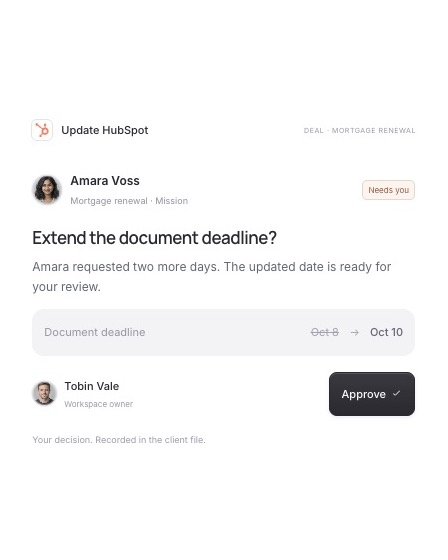
| Decision | Human approval by default for consequential actions (anything client-facing or written to a system of record), with controlled autonomy for low-risk, reversible tasks. Each business can adjust it per tool. |
| Success measures to validate | Workflow completion rate, approval frequency, time to complete a follow-up, and incorrect-action rate. |
Human judgment as a product feature
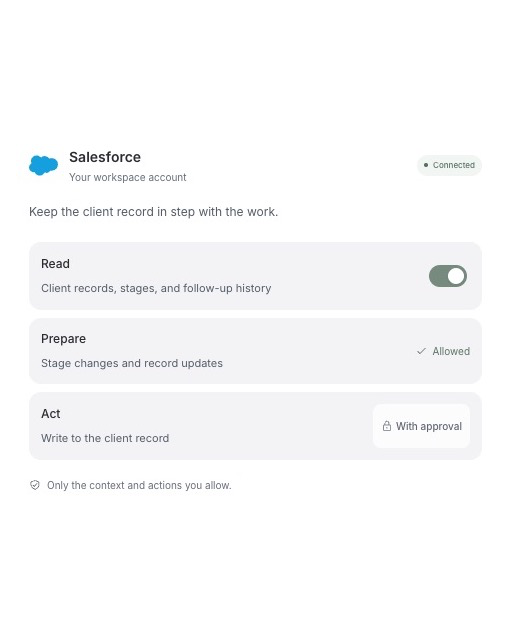
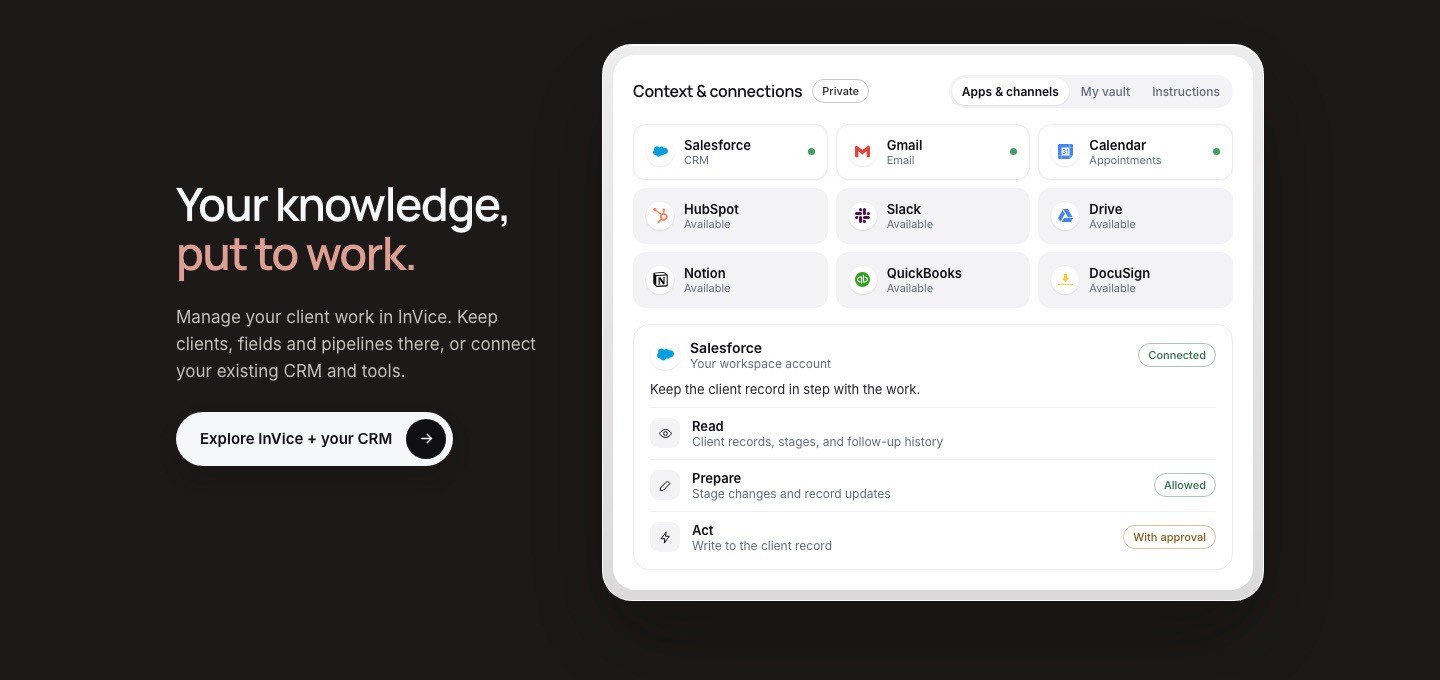
The core design decision is how much the AI is allowed to do on its own. Every connected tool has three separate permission levels, so a business can let an agent read freely, prepare changes, and write only with approval.
| Level | What the agent can do | Default |
|---|---|---|
| Read | Use client records, stages and history as context | On when connected |
| Prepare | Draft messages, stage record updates | Allowed |
| Act | Send, or write to the system of record | With approval |
Every action leaves a receipt that shows the context used, the reasoning and the rule it ran under, so a person can audit what happened.
Saying no on purpose
AI products drift easily into "do everything". Invice's principles name what it will not become: a generic CRM, a generic workflow builder or an integration marketplace. Features heading that way need an explicit product review. That keeps the roadmap focused on what makes the product different: following through on client goals.
Only claim what's verified
I keep a claims register: marketing and product copy may only state capabilities that have been proven in production. For example, Canadian data residency is a strategic requirement, but it isn't advertised until it has been verified end to end.
Bilingual, not translated
French copy is transcreated from a dedicated style guide rather than machine-translated, because the first market is Canadian and bilingual.
An open AI harness, not a closed box
Invice is designed as a harness that businesses plug their own tools and their own AI model into. Tools connect through MCP (Model Context Protocol) connectors and APIs. Businesses bring their own AI provider (Anthropic, OpenAI, Google or Mistral), so they aren't locked into one vendor. I've also positioned Invice for agent-to-agent (A2A) protocols, so other AI agents can work with it, not just people.
Privacy by design
Client data is sensitive, so data protection is part of the architecture rather than an add-on. Every workspace's data is isolated, connector credentials are encrypted, and audit logs record what happened without storing personal information. The design follows GDPR and Canadian privacy principles.
Trade-offs I made
- Approval before autonomy. Agents act alone only on low-risk, reversible actions; anything client-facing or written to a system of record waits for a person. Slower at first, but it earns trust.
- A layer, not another CRM. I chose not to build a full CRM or a generic workflow builder. Features heading that way need an explicit product review, which keeps the roadmap on client follow-through.
- Claims wait for proof. Canadian data residency stays off the marketing until it is verified end to end, even though it would help sales.
- Depth before breadth. One complete workflow first, then more channels and connectors.
Go-to-market groundwork: SEO, GEO and the Bullseye Framework
I'm planning Invice's acquisition with the Bullseye Framework from Traction by Gabriel Weinberg and Justin Mares: list every possible channel, run cheap tests on the most promising few, then focus on the one that works. Search is on the shortlist, so the site is built for SEO and GEO (generative engine optimization): clear, bilingual content that search engines can rank and AI assistants can understand and cite.
Evidence
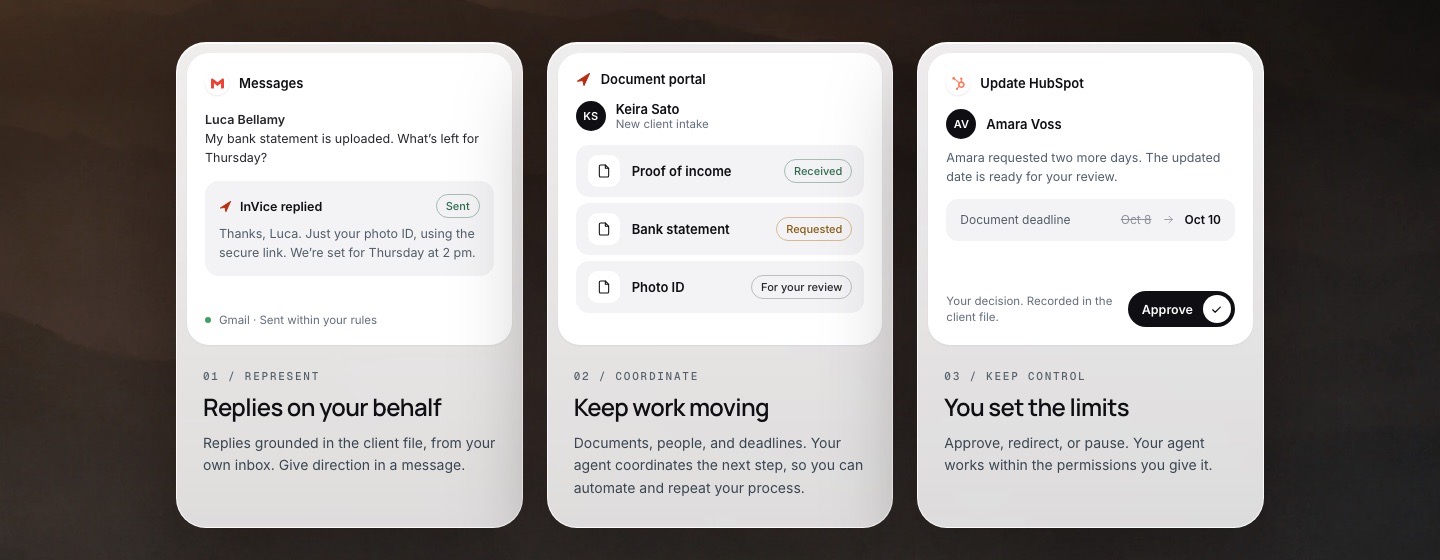
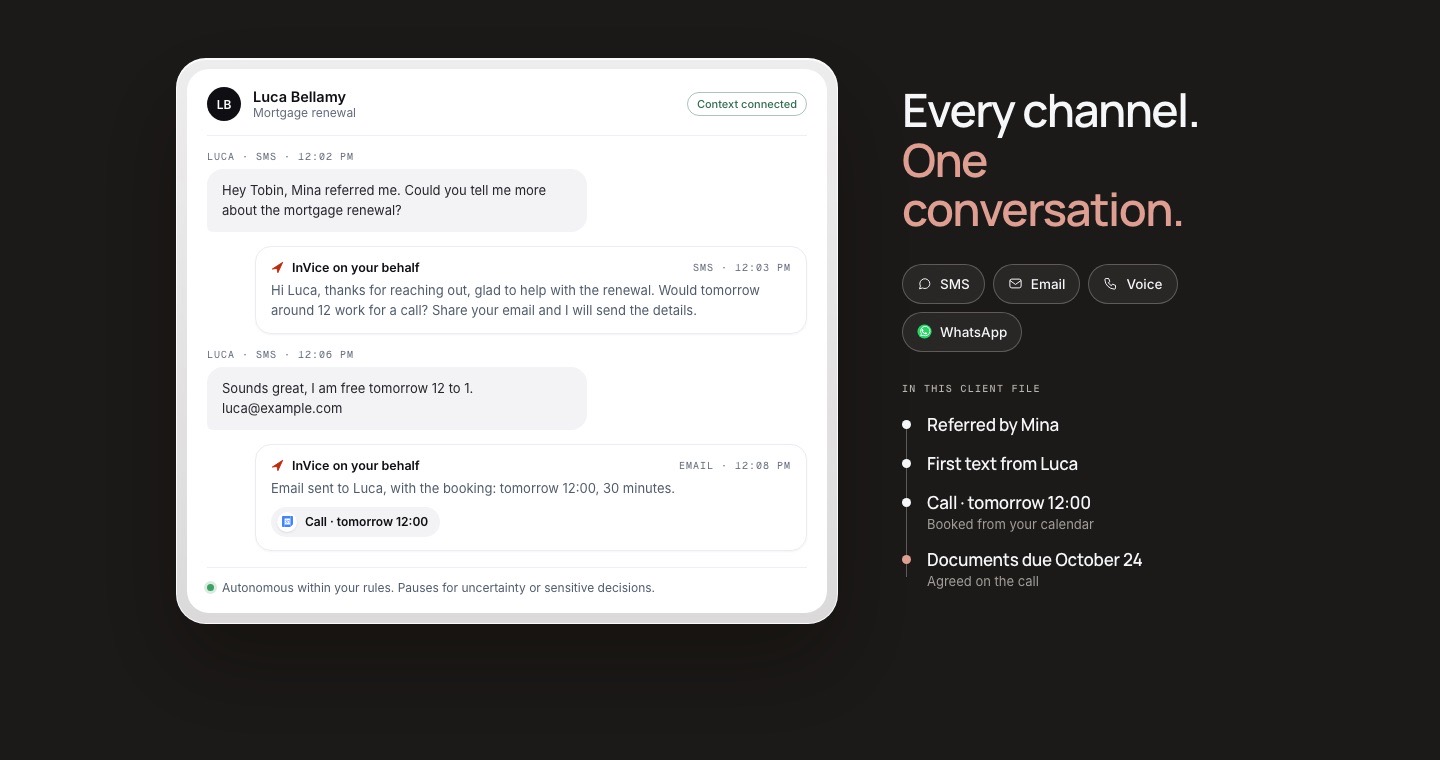
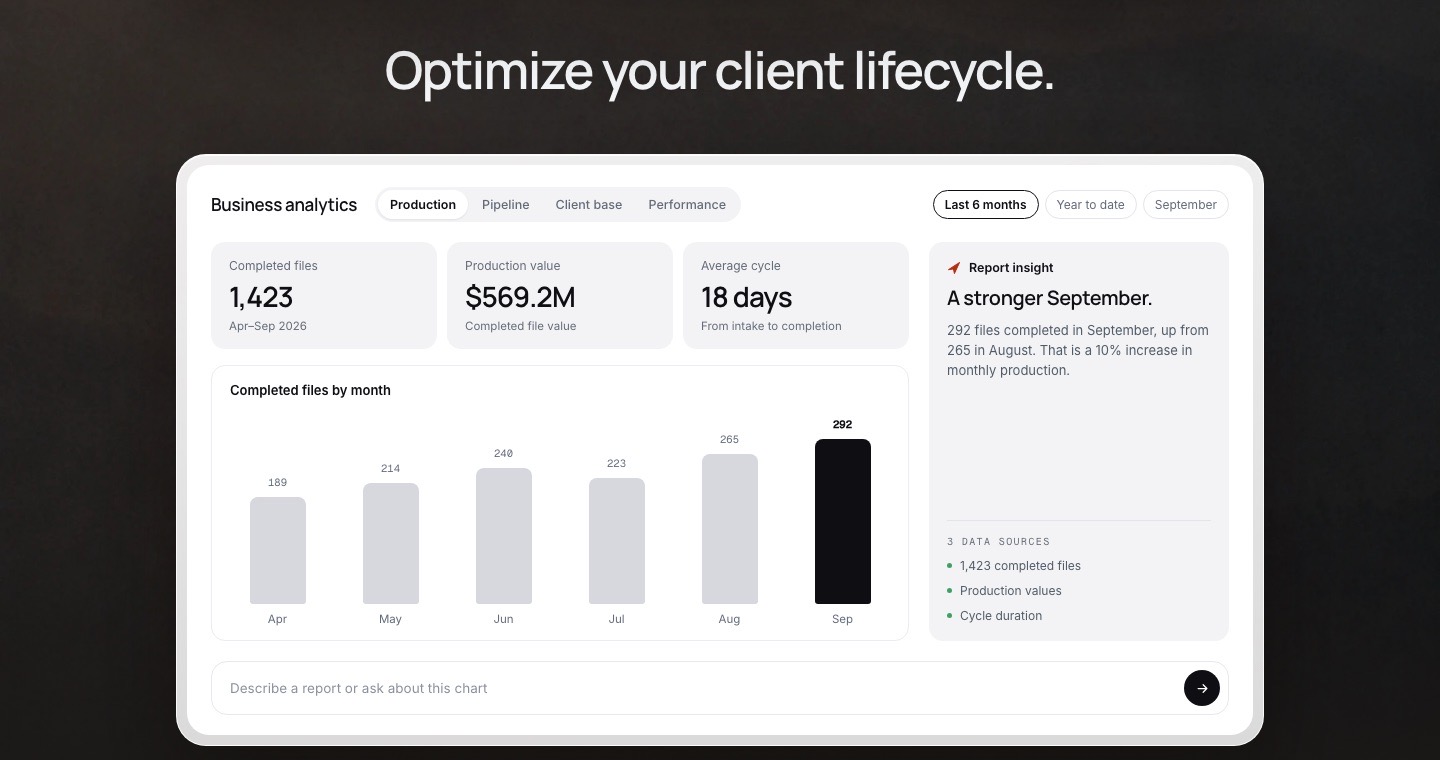
Product visuals from invice.ai. All names and figures are fictional demo data.
Results
The website is public at invice.ai and the product is in early access, with a launch list open. What exists today:
| Area | Status |
|---|---|
| Product | Early access; public site at invice.ai, in English and French |
| Human in the loop | Read, prepare and act permissions per tool, approvals and an audit trail |
| Integrations | MCP connectors and APIs to email, calendar and CRM tools |
| AI models | Bring your own provider: Anthropic, OpenAI, Google or Mistral |
Next, as the first workspaces go live: workflow completion rate, time saved per follow-up and the share of actions that need human approval.
Lessons learned
- The best product ideas come from the job. Invice exists because I spent two years as the person chasing documents in Salesforce. Knowing the user's day firsthand made it easier to decide what matters and what doesn't.
- Each project built on the last. Eatez taught me to own a vision and run sprints, Popera to build and maintain software end to end, and MacroBrief to work with APIs and automation. Invice combines all three, with AI agents, MCP and A2A on top.
- With AI, trust is the product. The hardest decisions weren't about what the AI can do, but what it should be allowed to do: permissions, approvals, audit trails and data privacy.
- Discipline scales better than features. Written product principles, a claims register and release gates keep a fast-moving AI project honest about what actually works.
Learn more: invice.ai ↗