Context
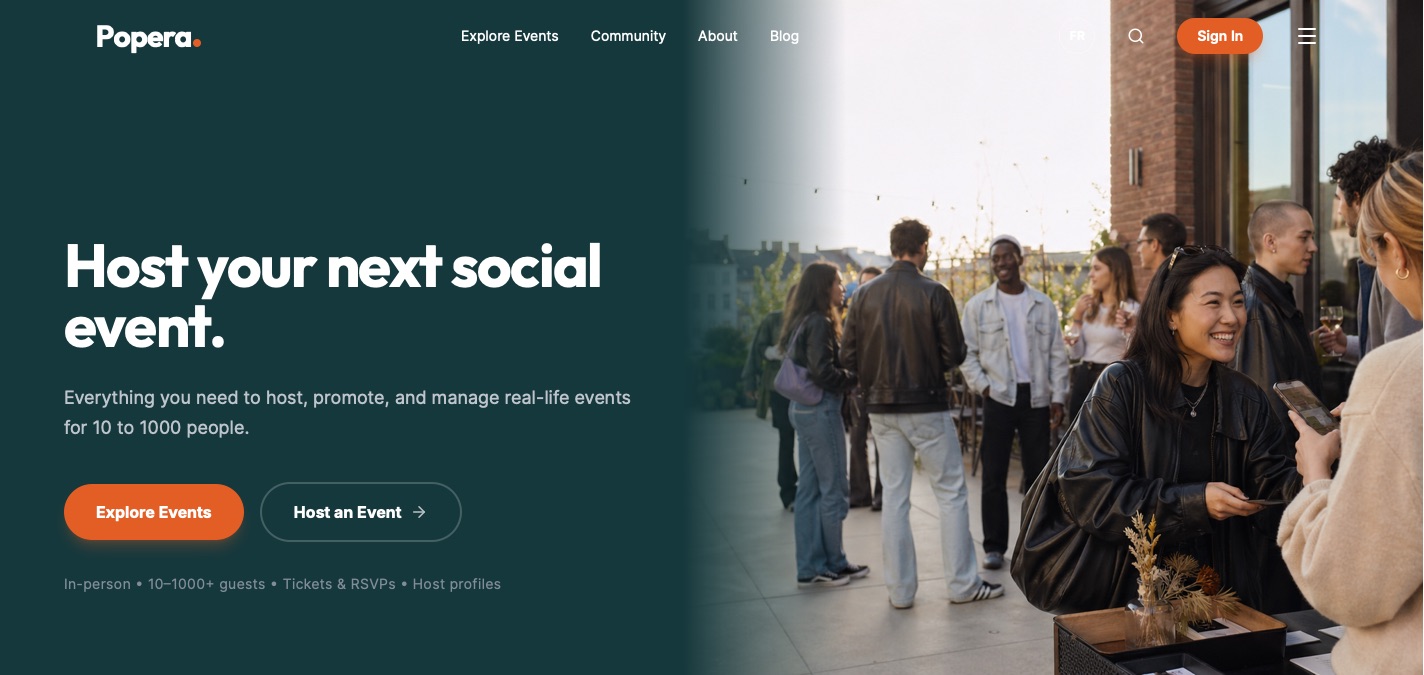
Small, local, in-person events like workshops, supper clubs, run clubs and book clubs are usually organized across a patchwork of tools: a ticketing site, a group chat, a payment app and social media. Big ticketing platforms are built for large public events, not for a host bringing 10 people together.
Two problems kept coming up: no-shows, and trust between strangers meeting in person.
I had seen both problems first-hand, organizing community events at Espace Canevas and running catering at Ke Ola.
Objective
Give hosts one place to publish, fill and run a real-life event, from the first RSVP to the day-of updates, while making attendees comfortable showing up.
My responsibilities
- Product strategy: defined the target users (event hosts and attendees), value proposition and feature set, and repositioned the product from small 3–10 person circles to events of 10 to 1,000 people.
- Full-stack development: designed, built and maintain the front end, back end, payments and messaging myself with AI-assisted development in Cursor.
- Integrations: integrated Stripe for payments, refunds and host identity verification, plus SMS and email notifications.
- Trust and safety: designed verification, reviews, chat moderation and the address-unlock flow.
- Release and operations: deploy, monitor and fix the live product; own uptime, bugs and security updates.
- Growth and go-to-market: created the brand identity, campaign visuals and bilingual content; run SEO, GEO and the blog; manage paid campaigns on Google, Meta and TikTok.
Coursework applied: Agile methods and project management tools · Information systems project management · Marketing.
Strategy & execution
Building it myself
After leading a contracted team on Eatez, I wanted to close the gap between deciding and shipping. With Cursor, I could turn a requirement into working software the same day, test it with real flows, and iterate without waiting on a sprint. That made me responsible for everything a product team normally splits up: architecture, payments, security, bugs and uptime.
Designing for the two real problems
| Problem | Product response |
|---|---|
| No-shows | Optional commitment fee to reserve a spot, shown upfront, refundable based on host settings; automatic refunds if an event is cancelled. |
| Trust between strangers | Host identity verified through Stripe Identity and phone, public reviews, moderated group chats, and the exact address revealed only after a confirmed reservation. |
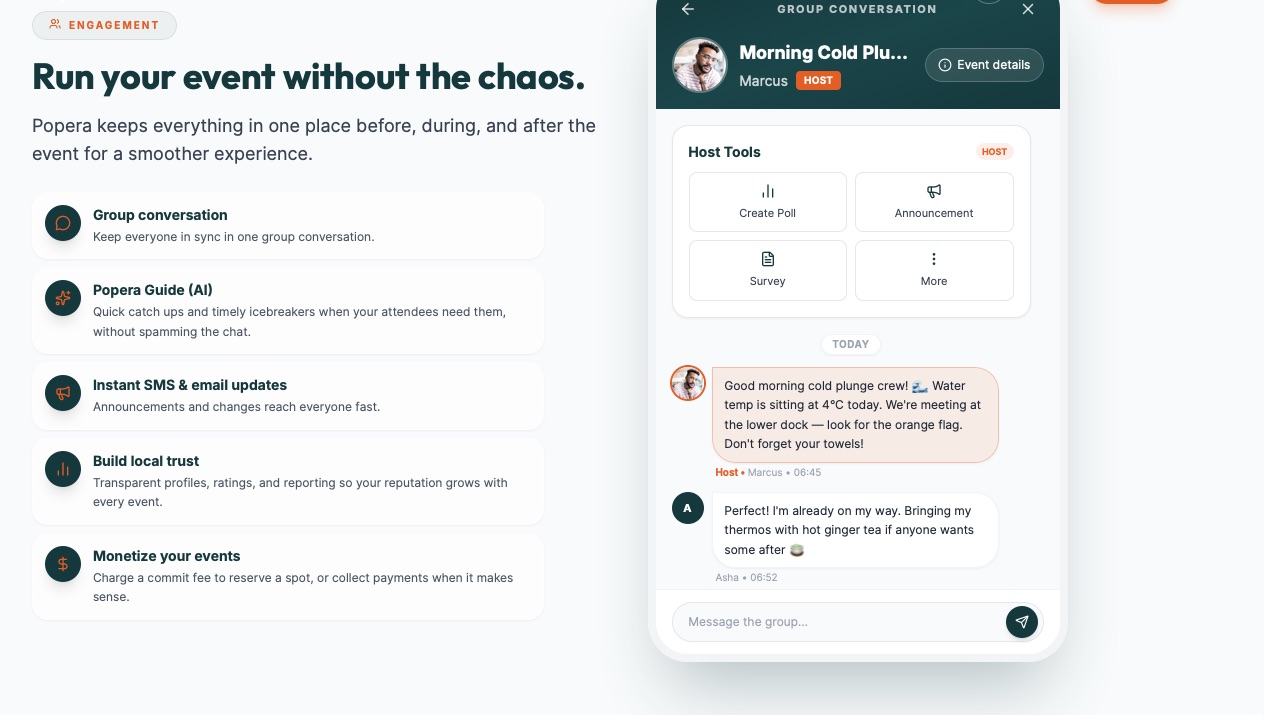
| Coordination chaos | One group conversation per event, with host tools (polls, announcements, surveys), SMS and email updates, and an AI guide for icebreakers and catch-ups. |
Positioning against the incumbents
Rather than compete with large ticketing platforms head on, Popera focuses on intimate, peer-hosted events of 3 to 10 seats and up, a segment those tools serve poorly. The blog makes that case directly, for example in a comparison with Eventbrite.
Trade-offs I made
- From circles to events. Popera started as small 3–10 person circles in public spaces. I widened it to events of 10 to 1,000 people to serve more hosts and more ways of gathering.
- Web first. Launching as a web app let me ship and iterate faster on my own than separate native apps would.
- An optional commitment fee. Hosts can protect themselves from no-shows without blocking free events.
Growth: SEO, GEO and paid campaigns
I ran paid campaigns on Google, Meta and TikTok, and tracked organic search in Google Search Console. Using the Bullseye Framework from Traction, I tested channels cheaply before committing budget. The blog answers the questions hosts actually search for, such as comparisons with Eventbrite and guides for small events, written for both search engines and AI assistants.
Evidence

Results
| Item | Result |
|---|---|
| Product live | Yes · gopopera.ca, English and French |
| Payments and identity | Stripe payments, refunds and identity verification in production |
| Acquisition | Paid campaigns on Google, Meta and TikTok; SEO and GEO content through the blog |
Lessons learned
- Owning the full stack changes how you write requirements. Building with Cursor taught me to break features into small, testable pieces with clear acceptance criteria, because that's what produces reliable software, whether the builder is a person or an AI.
- Shipping is the start, not the finish. Running a live product means payments, refunds, security and bugs that real users hit. Maintaining it taught me to think about operations and reliability from day one.
- AI-assisted development is a skill, not a shortcut. The tools are fast, but the judgment still has to come from you: what to build, how to structure it, and when the output is wrong.
Learn more: gopopera.ca ↗